
Written by: Wasima Binte Hossain Putul, Deputy Lead, Policy Advocacy
Designed by: Mobaraz Ahmed, Lead, Creative Team
𝐄𝐱𝐞𝐜𝐮𝐭𝐢𝐯𝐞 𝐒𝐮𝐦𝐦𝐚𝐫𝐲
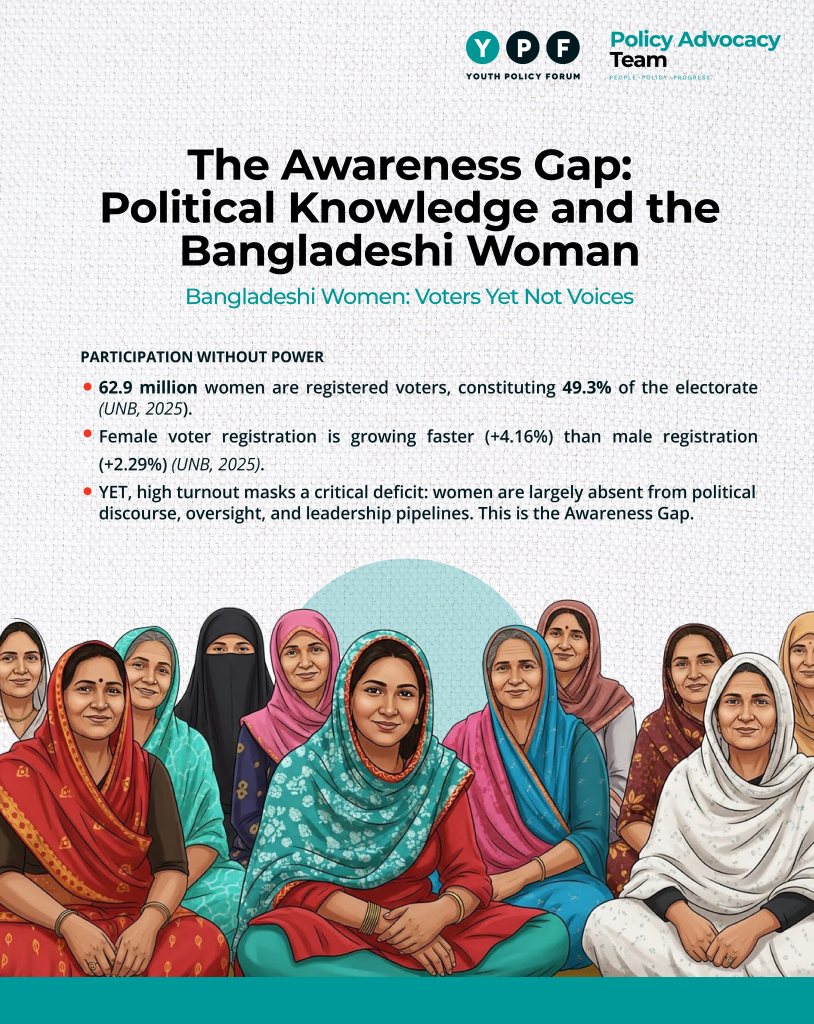
- 62.9M women voters (49.3%) by Nov 2025, but awareness does not match turnout.
- Women register and vote at high rates, yet rarely engage in political discussion, oversight, or leadership (UNB, 2025).
- 𝐏𝐨𝐥𝐢𝐭𝐢𝐜𝐚𝐥 𝐥𝐢𝐭𝐞𝐫𝐚𝐜𝐲 𝐠𝐚𝐩: many recognize national leaders, but few understand roles, rights, budgets, or accountability paths (Hassan et al., 2024).
- 𝐏𝐨𝐥𝐢𝐭𝐢𝐜𝐚𝐥 𝐝𝐢𝐬𝐜𝐨𝐮𝐫𝐬𝐞 𝐠𝐚𝐩: 90%+ women “never/almost never” discuss politics with friends, leading to weaker independent opinion-forming (Hassan et al., 2024).
- 𝐋𝐨𝐜𝐚𝐥-𝐯𝐨𝐢𝐜𝐞 𝐠𝐚𝐩: 13.4% women contacted the local government on community issues vs 23.4% of men (Hassan et al., 2024).
- 𝐃𝐢𝐠𝐢𝐭𝐚𝐥 𝐩𝐚𝐫𝐚𝐝𝐨𝐱: phones and internet reach have grown, but few women create, lead, or mobilize online due to skills deficit and safety fears (Hassan et al., 2024).
- 𝐎𝐧𝐥𝐢𝐧𝐞 𝐬𝐚𝐟𝐞𝐭𝐲: only ~14% feel safe posting political opinions (women are more cautious) (Hassan et al., 2024). That leads to self-censorship, limiting learning.
- 𝐒𝐡𝐚𝐫𝐩𝐞 𝐝𝐢𝐠𝐢𝐭𝐚𝐥 𝐬𝐤𝐢𝐥𝐥𝐬 𝐠𝐚𝐩: young men dominate strategic digital activism; young women remain political-content consumers, not shapers (Amin & Tasnim, 2025).
- 𝐕𝐢𝐨𝐥𝐞𝐧𝐜𝐞 & 𝐢𝐧𝐭𝐢𝐦𝐢𝐝𝐚𝐭𝐢𝐨𝐧 𝐬𝐡𝐫𝐢𝐧𝐤 𝐚𝐰𝐚𝐫𝐞𝐧𝐞𝐬𝐬: fear of psychological, physical, and sexual harm keeps women out of public debate and candidate pipelines (Haque, 2023).
- 𝐄𝐝𝐮𝐜𝐚𝐭𝐢𝐨𝐧 𝐦𝐢𝐬𝐦𝐚𝐭𝐜𝐡: schooling raises critical thinking, but early marriage and institutional distrust cut access to civic learning and long-term engagement (Murshed, 2025; F. Rahman, 2014; Schuler et al., 2010; “নারীর রাজনৈতিক সচেতনতা,” n.d)).
- Deepest awareness gaps fall on marginalized women (caste, disability, poverty, rurality, minorities) (Islam, n.d.; Murshed, n.d.; Women for Politics, 2022). Exclusion is often actively enforced.
- The gap shows a country where women’s votes are counted, but autonomous political will and influence remain limited.
𝗜𝗻𝘁𝗿𝗼𝗱𝘂𝗰𝘁𝗶𝗼𝗻
By November 2025, about 62.9 million women had been voters in Bangladesh, roughly 49.3% of the electorate (UNB, 2025). That headline sounds like progress. But beneath it lies an “awareness gap”; a layered deficit in political knowledge, conversational practice, digital agency, and institutional access that often turns ballots into ritual rather than a process of accountability and change.
𝗣𝗮𝗿𝘁𝗶𝗰𝗶𝗽𝗮𝘁𝗶𝗼𝗻 𝗪𝗶𝘁𝗵𝗼𝘂𝘁 𝗣𝗼𝘄𝗲𝗿
Bangladesh’s political history looks contradictory on the surface. Women have led the country at the highest level for decades. Registration and turnout numbers are strong, and outreach increased women’s registration faster in 2025 (+4.16%) than men (+2.29%) (UNB, 2025). Yet that mass visibility at the top has not produced mass political agency at the base.
A short history may explain why. Rural Bangladesh in the 1980s-1990s kept women largely out of public life through very low literacy, restricted mobility, and almost no channels for civic learning (Murshed, 2025; Shahria, 2025). Formal gains since then, such as laws, quotas, NGO programmes, and wider school enrolment, have not fully reshaped the social processes that create political consciousness. Constitutional guarantees of equality (Articles 10, 19, and 28) clash with everyday realities (Murshed, 2025; Shahria, 2025). Economic dependence, patriarchal guardianship of land and movement, and the deliberate use of stigma and intimidation result in the paradox of presence without agency (Hasan, n.d.; F. Rahman, 2014; Shahria, 2025). Millions of women are counted at the polls but too often remain unable to form, express, or act on independent political judgment.
𝗧𝗵𝗲 𝗦𝘁𝗮𝘁𝗲 𝗼𝗳 𝗣𝗼𝗹𝗶𝘁𝗶𝗰𝗮𝗹 𝗔𝘄𝗮𝗿𝗲𝗻𝗲𝘀𝘀: 𝗪𝗵𝗮𝘁 𝘁𝗵𝗲 𝗘𝘃𝗶𝗱𝗲𝗻𝗰𝗲 𝗦𝗵𝗼𝘄𝘀
- 𝐑𝐞𝐠𝐢𝐬𝐭𝐫𝐚𝐭𝐢𝐨𝐧 𝐚𝐧𝐝 𝐫𝐞𝐟𝐨𝐫𝐦 𝐚𝐰𝐚𝐫𝐞𝐧𝐞𝐬𝐬: Outreach raised registration, but technical knowledge is limited. In an October 2025 poll, a majority of women had not heard of a proposed proportional-representation reform, and only 15.5% supported it (vs. 27% of men) (The Business Standard, 2025). Knowing the mechanics of representation shapes whether citizens can press for institutional change. Without it, reform debates can’t happen.
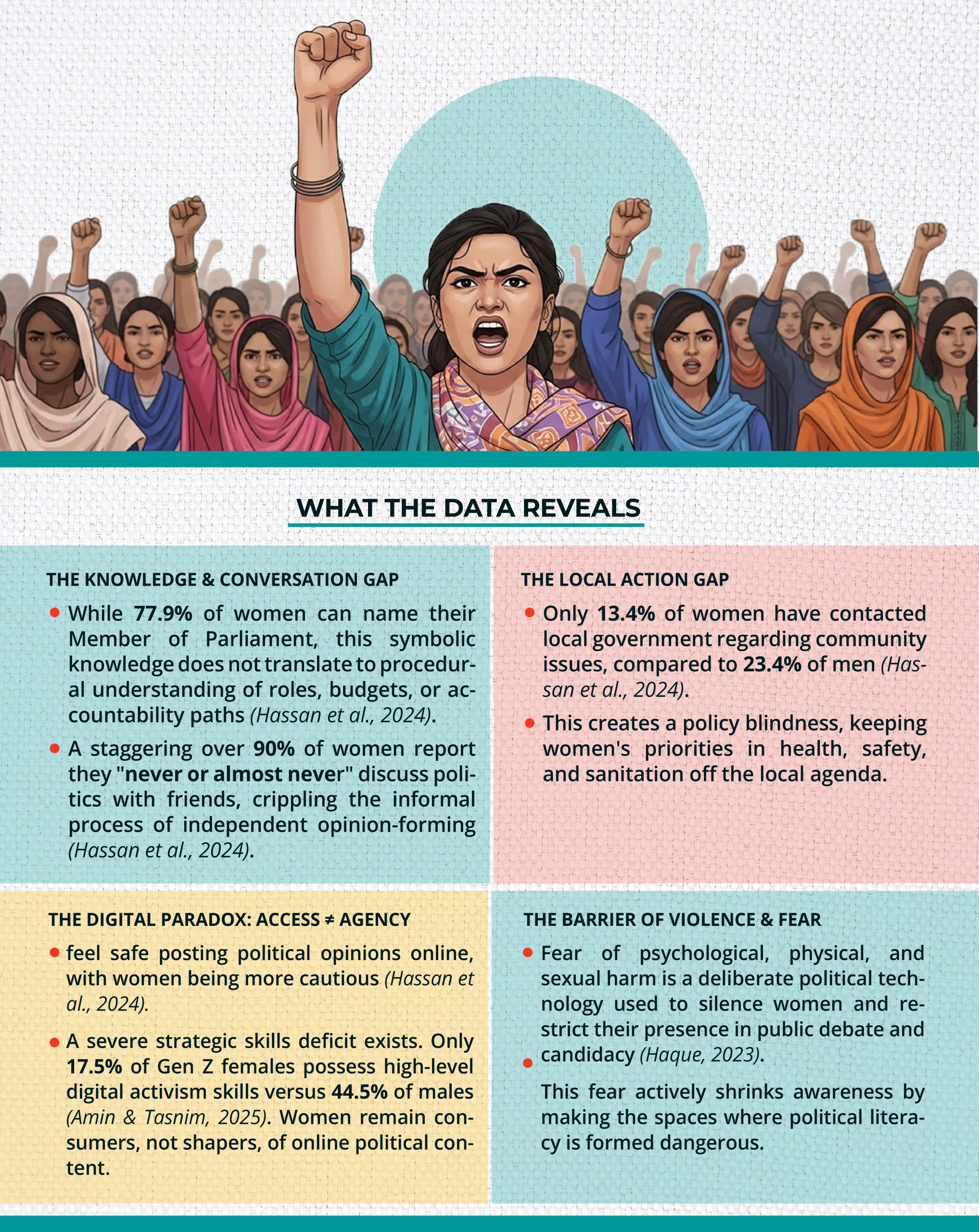
- 𝐊𝐧𝐨𝐰𝐥𝐞𝐝𝐠𝐞, 𝐝𝐢𝐬𝐜𝐮𝐬𝐬𝐢𝐨𝐧, 𝐚𝐧𝐝 𝐥𝐨𝐜𝐚𝐥 𝐞𝐧𝐠𝐚𝐠𝐞𝐦𝐞𝐧𝐭: While many can name national figures, gender gaps persist in civic knowledge. According to a survey by the Asia Foundation, 77.9% of women could name their MP versus 95.5% of men (Hassan et al., 2024). Yet naming is only the first step. Very few understand powers, oversight paths or complaint mechanisms. Social life compounds this. Over 90% of women report they “almost never” or “never” discuss politics with friends, a gap that prevents opinion-formation (Hassan et al., 2024). Locally, only 13.4% of women contacted local government about community issues in the past year (vs 23.4% of men), though both sexes contact officials at similar rates for personal matters (~40%) (Hassan et al., 2024). The gendered split between private and public contact is striking.
- 𝐃𝐢𝐠𝐢𝐭𝐚𝐥 𝐚𝐜𝐜𝐞𝐬𝐬 𝐚𝐧𝐝 𝐬𝐭𝐫𝐚𝐭𝐞𝐠𝐢𝐜 𝐬𝐤𝐢𝐥𝐥𝐬: Access has improved. roughly 68.5% of women own a phone, and 35.3% have mobile internet (Hassan et al., 2024). But access does not equal agency. Few feel safe sharing political views online. Only 13.9% overall say they often feel safe posting political opinions (Hassan et al., 2024). The skills gap is sharper among Gen Z. Only 17.5% of females have high-level strategic digital skills (vs 44.5% of males); among Millennials, the gap is 12% (female) vs 26.5% (male) (Amin & Tasnim, 2025). That means many young women consume political content, but far fewer create, organize, or run digital campaigns.
- 𝐕𝐢𝐨𝐥𝐞𝐧𝐜𝐞 𝐚𝐧𝐝 𝐢𝐧𝐭𝐢𝐦𝐢𝐝𝐚𝐭𝐢𝐨𝐧: Violence and fear limit not only women’s participation but also their political learning. When public debate, meetings, and online expression carry the threat of psychological, physical, or sexual harm, many women opt out of the very spaces where political awareness and literacy are formed (Haque, 2023). This helps explain why women turn out to vote in vast numbers, yet far fewer engage in the discussions and roles that build an independent political voice.
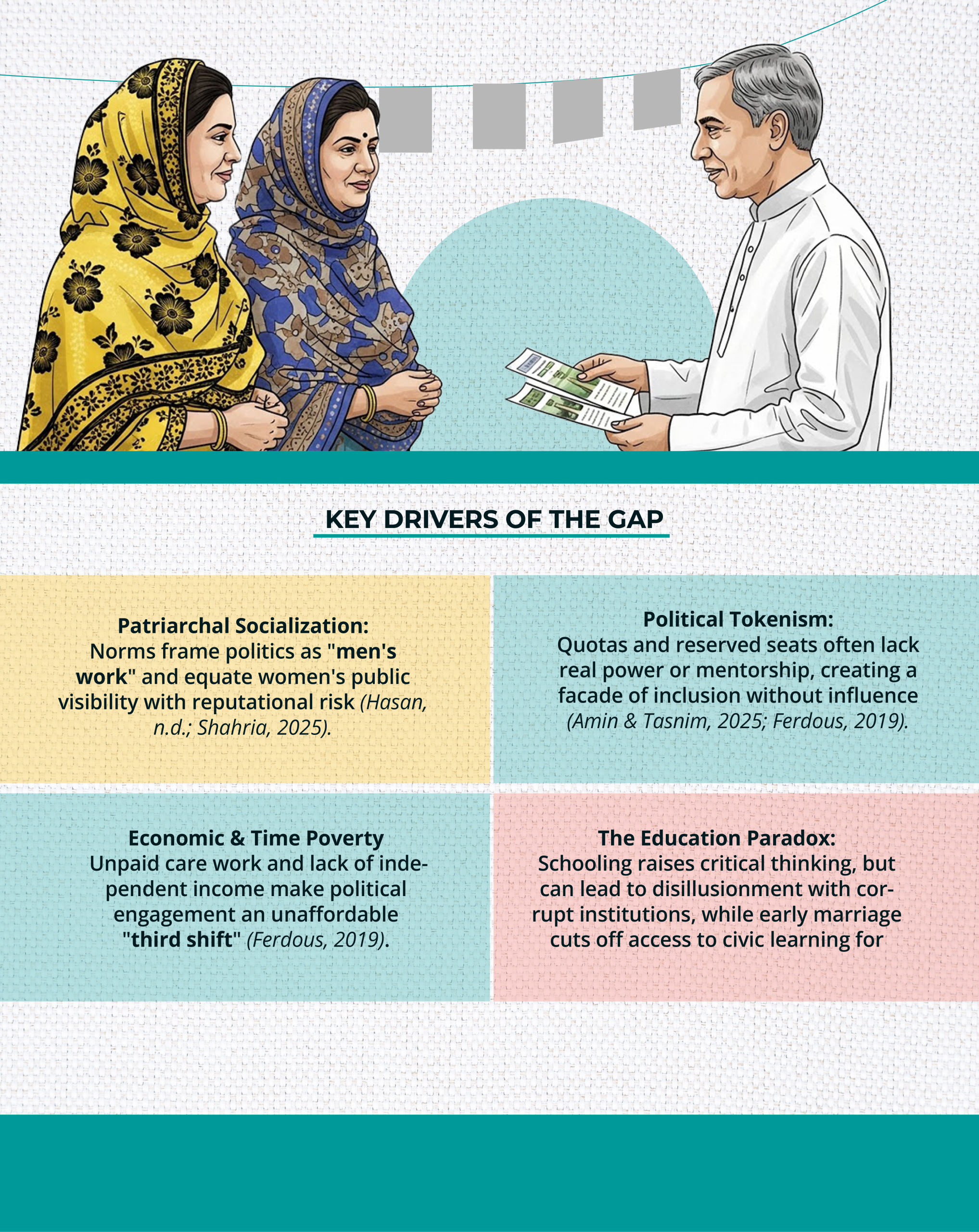
- 𝐄𝐝𝐮𝐜𝐚𝐭𝐢𝐨𝐧 𝐚𝐧𝐝 𝐭𝐡𝐞 𝐩𝐚𝐫𝐚𝐝𝐨𝐱 𝐨𝐟 𝐞𝐧𝐠𝐚𝐠𝐞𝐦𝐞𝐧𝐭: Education matters, but not in a simple linear way. Some surveys show that formally educated women vote less than those without schooling (Murshed, 2025). This paradox often reflects critical disengagement. Education raises expectations and critical capacity, but when institutions disappoint, educated women can withdraw. Simultaneously, early marriage (in many samples affecting roughly half of girls) truncates schooling and removes young women from the social spaces where political awareness grows (F. Rahman, 2014; Schuler et al., 2010; “নারীর রাজনৈতিক সচেতনতা,” n.d).
𝗛𝗼𝘄 𝘁𝗵𝗲 𝗔𝘄𝗮𝗿𝗲𝗻𝗲𝘀𝘀 𝗚𝗮𝗽 𝗢𝗽𝗲𝗿𝗮𝘁𝗲𝘀 𝗶𝗻 𝗣𝗿𝗮𝗰𝘁𝗶𝗰𝗲
- 𝐂𝐨𝐧𝐯𝐞𝐫𝐬𝐚𝐭𝐢𝐨𝐧𝐚𝐥 𝐬𝐢𝐥𝐞𝐧𝐜𝐞 𝐛𝐞𝐜𝐨𝐦𝐞𝐬 𝐩𝐨𝐥𝐢𝐭𝐢𝐜𝐚𝐥 𝐰𝐞𝐚𝐤𝐧𝐞𝐬𝐬: Politics is learned in talk; household chatter, market debates, workplace arguments. When over 90% of women rarely discuss politics, they lose the practice and confidence needed to voice opinions publicly (Hassan et al., 2024).
- 𝐋𝐨𝐜𝐚𝐥 𝐢𝐧𝐯𝐢𝐬𝐢𝐛𝐢𝐥𝐢𝐭𝐲, 𝐧𝐚𝐭𝐢𝐨𝐧𝐚𝐥 𝐜𝐨𝐬𝐭: Low contact with local government for community issues keeps women’s priorities, such as health, sanitation, safety, and informal labour protections, off the agenda. The result is policy neglect where it matters most.
- 𝐃𝐢𝐠𝐢𝐭𝐚𝐥 𝐫𝐞𝐚𝐜𝐡 𝐰𝐢𝐭𝐡 𝐥𝐢𝐦𝐢𝐭𝐞𝐝 𝐫𝐞𝐚𝐜𝐡-𝐛𝐚𝐜𝐤: Phones broaden access, but without protective norms and skills, online spaces amplify male voices (Amin & Tasnim, 2025). Low feelings of safety and a lack of content-creation ability keep women as consumers rather than shapers (Ferdous, 2019).
- 𝐑𝐞𝐜𝐨𝐠𝐧𝐢𝐭𝐢𝐨𝐧 𝐰𝐢𝐭𝐡𝐨𝐮𝐭 𝐚𝐜𝐜𝐨𝐮𝐧𝐭𝐚𝐛𝐢𝐥𝐢𝐭𝐲: Knowing an MP’s name is symbolic. Knowing how to lodge complaints, read a budget, or convene a local meeting is instrumental. The gap between symbolic and procedural literacy leaves women unable to hold power to account.
- 𝐄𝐝𝐮𝐜𝐚𝐭𝐢𝐨𝐧’𝐬 𝐝𝐨𝐮𝐛𝐥𝐞 𝐞𝐝𝐠𝐞: Education expands critical thought, but can increase disillusionment when institutions fail (Murshed, 2025). Meanwhile, child marriage and poverty keep many girls from ever accessing schooling that would nurture civic life (F. Rahman, 2014; Schuler et al., 2010; “নারীর রাজনৈতিক সচেতনতা,” n.d).
- 𝐈𝐧𝐭𝐞𝐫𝐬𝐞𝐜𝐭𝐢𝐨𝐧𝐚𝐥 𝐰𝐞𝐚𝐩𝐨𝐧𝐢𝐳𝐚𝐭𝐢𝐨𝐧: For Dalit, trans, disabled and minority women, exclusion is actively enforced. Eviction, property grabs, sexualized violence and communal intimidation make political participation a life-risk rather than a civic choice (Islam, n.d.; Murshed, n.d.; Women for Politics, 2022).
These patterns interact. Silence reduces digital confidence; weak local pressure reduces incentives to learn institutional levers; marginalization snowballs every barrier into near-total exclusion.
𝗦𝗵𝗮𝗽𝗲𝗿𝘀 𝗼𝗳 𝗖𝗼𝗻𝘀𝗰𝗶𝗼𝘂𝘀𝗻𝗲𝘀𝘀: 𝘁𝗵𝗲 𝗦𝗼𝗰𝗶𝗮𝗹, 𝗣𝗼𝗹𝗶𝘁𝗶𝗰𝗮𝗹, 𝗮𝗻𝗱 𝗗𝗶𝗴𝗶𝘁𝗮𝗹 𝗙𝗮𝗰𝘁𝗼𝗿𝘀 𝗼𝗳 𝗘𝘅𝗰𝗹𝘂𝘀𝗶𝗼𝗻
- 𝐏𝐚𝐭𝐫𝐢𝐚𝐫𝐜𝐡𝐚𝐥 𝐬𝐨𝐜𝐢𝐚𝐥𝐢𝐳𝐚𝐭𝐢𝐨𝐧 𝐚𝐧𝐝 𝐠𝐞𝐧𝐝𝐞𝐫𝐞𝐝 𝐧𝐨𝐫𝐦𝐬: From childhood, many girls are taught restricted mobility, deferential speech, and household-first loyalties. Politics is framed as men’s work; public visibility risks damaging one’s reputation (Hasan, n.d.; F. Rahman, 2014; Shahria, 2025; Ferdous, 2019). These norms are enforced in families, schools, and local institutions, conditioning many women away from public discourse and leadership.
- 𝐕𝐢𝐨𝐥𝐞𝐧𝐜𝐞 𝐚𝐬 𝐚 𝐩𝐨𝐥𝐢𝐭𝐢𝐜𝐚𝐥 𝐭𝐞𝐜𝐡𝐧𝐨𝐥𝐨𝐠𝐲: Psychological intimidation is widespread. The threat of physical or sexual violence is ever-present for those who step outside prescribed roles. The use of gendered violence to stop candidates or silence activists demonstrates that exclusion is not passive but actively defended (Haque, 2023).
- 𝐏𝐨𝐥𝐢𝐭𝐢𝐜𝐚𝐥 𝐢𝐧𝐬𝐭𝐫𝐮𝐦𝐞𝐧𝐭𝐚𝐥𝐢𝐳𝐚𝐭𝐢𝐨𝐧 𝐚𝐧𝐝 𝐭𝐨𝐤𝐞𝐧𝐢𝐬𝐦: Parties often prefer predictable blocs they can mobilize. Quotas and reserved seats without resources, mentorship, or real decision-making power produce token inclusion rather than pipelines into influence (Amin & Tasnim, 2025; Ferdous, 2019). When parties profit from women’s predictable turnout, there is little incentive to invest in their political education.
- 𝐄𝐜𝐨𝐧𝐨𝐦𝐢𝐜 𝐜𝐨𝐧𝐬𝐭𝐫𝐚𝐢𝐧𝐭𝐬 𝐚𝐧𝐝 𝐭𝐢𝐦𝐞 𝐩𝐨𝐯𝐞𝐫𝐭𝐲: Politics demands time, money, and mobility. Women shoulder unpaid care work and often lack independent income; politics becomes an unaffordable “third shift” (Ferdous, 2019). Without childcare, campaign funds, or paid time for civic work, political participation is structurally out of reach.
- 𝐌𝐞𝐝𝐢𝐚 𝐧𝐞𝐠𝐥𝐞𝐜𝐭 𝐚𝐧𝐝 𝐰𝐞𝐚𝐩𝐨𝐧𝐢𝐬𝐞𝐝 𝐝𝐢𝐠𝐢𝐭𝐚𝐥 𝐬𝐩𝐚𝐜𝐞𝐬: The digital revolution could democratize voice, but the field is uneven. Three layers matter: first-level access (devices, connectivity), second-level skills (content creation, campaign tooling, fact-checking), and third-level outcomes (ability to shape discourse and mobilize) (Amin & Tasnim, 2025). Bangladesh has made strides in first-level access, but second- and third-level divides remain stark and gendered (Amin & Tasnim, 2025). Mainstream media underreports women’s issues; social media can become a site of targeted disinformation and organized harassment, sometimes from politically organized groups (Ferdous, 2019). Without strategic digital skills and safety, the internet becomes a battlefield that reproduces offline exclusion rather than bridges it.
- 𝐑𝐞𝐥𝐢𝐠𝐢𝐨𝐧, 𝐜𝐮𝐥𝐭𝐮𝐫𝐞, 𝐚𝐧𝐝 𝐭𝐡𝐞 𝐦𝐢𝐬𝐚𝐩𝐩𝐥𝐢𝐜𝐚𝐭𝐢𝐨𝐧 𝐨𝐟 𝐧𝐨𝐫𝐦𝐬: Religious and cultural norms are sometimes invoked to justify restrictions on women’s mobility and voice. The problem is not faith itself but its misapplication by patriarchal actors to legitimize control. (Ferdous, 2019; F. Rahman, 2014)
- 𝐂𝐨𝐦𝐩𝐨𝐮𝐧𝐝𝐞𝐝 𝐬𝐭𝐫𝐮𝐜𝐭𝐮𝐫𝐚𝐥 𝐞𝐱𝐜𝐥𝐮𝐬𝐢𝐨𝐧: Geography (rural vs urban), class and caste deepen these filters. When survival is the daily struggle, political learning is a luxury. The mechanism of exclusion thus operates across home, community, party and digital space to keep political consciousness from developing into collective power.
𝗠𝘆𝘁𝗵 𝘃𝘀. 𝗥𝗲𝗮𝗹𝗶𝘁𝘆: 𝗔𝗿𝗲 𝗪𝗼𝗺𝗲𝗻 𝗔𝗰𝘁𝘂𝗮𝗹𝗹𝘆 𝗨𝗻𝗶𝗻𝘁𝗲𝗿𝗲𝘀𝘁𝗲𝗱 𝗶𝗻 𝗣𝗼𝗹𝗶𝘁𝗶𝗰𝘀?
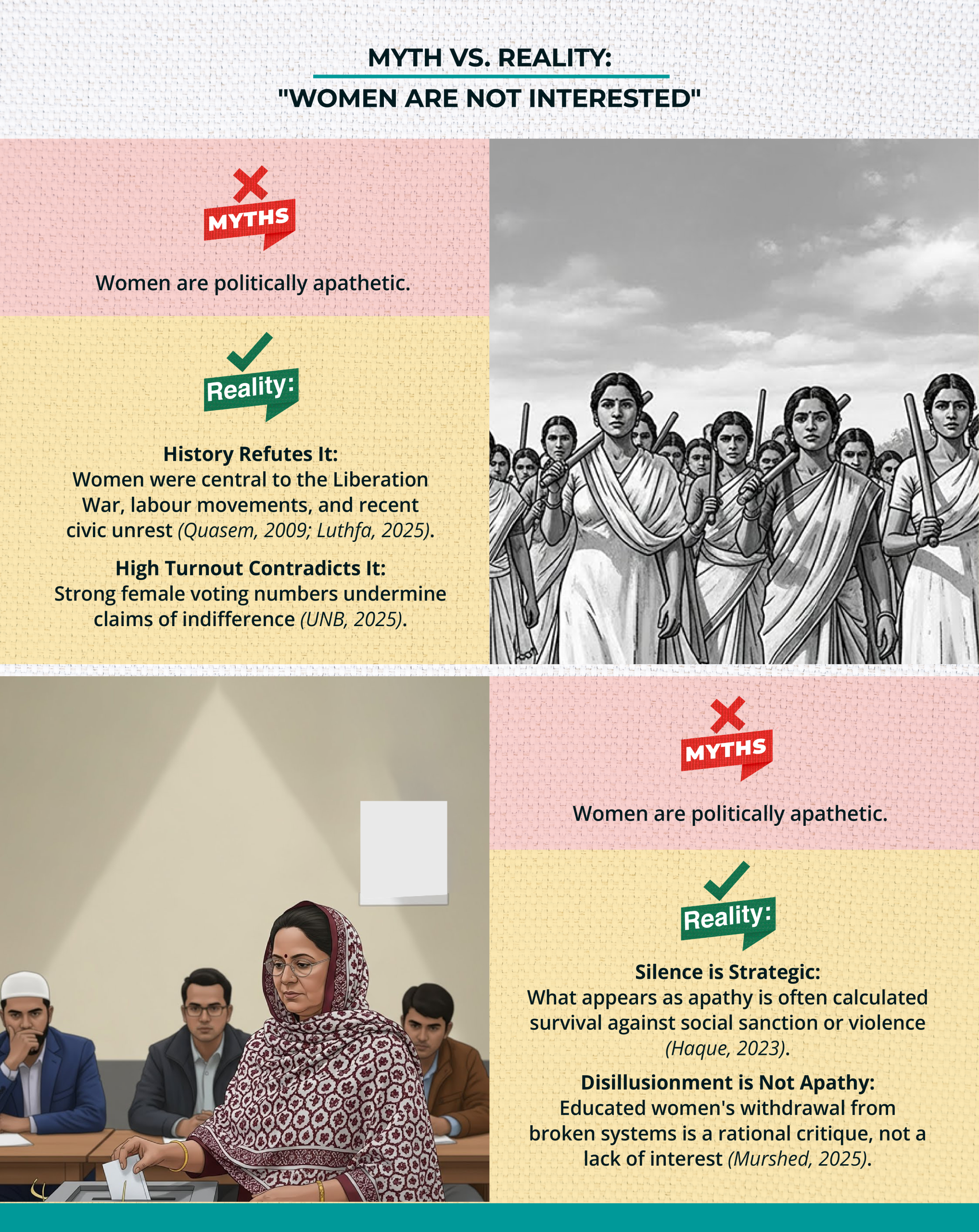
- 𝐇𝐢𝐬𝐭𝐨𝐫𝐲 𝐫𝐞𝐟𝐮𝐭𝐞𝐬 𝐚𝐩𝐚𝐭𝐡𝐲: Women have been central to major movements in Bangladesh, from anti-colonial campaigns, the Liberation War, labour mobilizations, to the recent July uprising (Quasem, 2009; Luthfa, 2025). These episodes show not passivity but political courage.
- 𝐖𝐨𝐦𝐞𝐧 𝐚𝐜𝐭 𝐰𝐡𝐞𝐧 𝐭𝐡𝐞𝐲 𝐡𝐚𝐯𝐞 𝐭𝐡𝐞 𝐭𝐨𝐨𝐥𝐬: Young women volunteer and organise when they have safe spaces and supportive networks. Gen Z shows higher volunteering in some measures; women participate in demonstrations, online campaigns, and local organizing when costs are manageable, and risks are mitigated (Amin & Tasnim, 2025; Sabur, 2022).
- 𝐇𝐢𝐠𝐡 𝐭𝐮𝐫𝐧𝐨𝐮𝐭 𝐜𝐨𝐧𝐭𝐫𝐚𝐝𝐢𝐜𝐭𝐬 𝐢𝐧𝐝𝐢𝐟𝐟𝐞𝐫𝐞𝐧𝐜𝐞: The simple fact of strong female turnout undermines claims of disinterest (UNB, 2025).
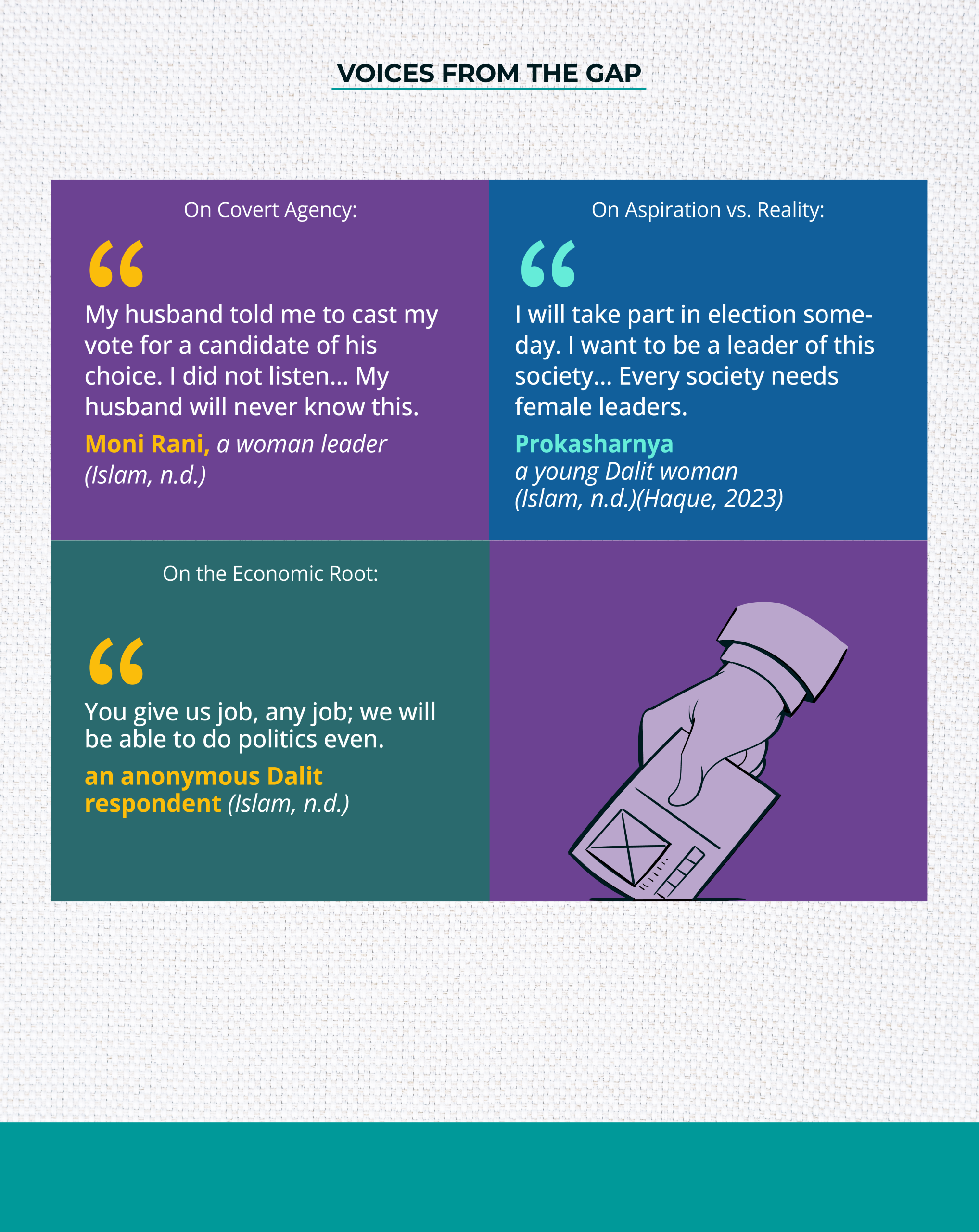
- 𝐖𝐡𝐚𝐭 𝐥𝐨𝐨𝐤𝐬 𝐥𝐢𝐤𝐞 𝐚𝐩𝐚𝐭𝐡𝐲 𝐢𝐬 𝐨𝐟𝐭𝐞𝐧 𝐜𝐚𝐥𝐜𝐮𝐥𝐚𝐭𝐞𝐝 𝐬𝐮𝐫𝐯𝐢𝐯𝐚𝐥: Silence is frequently strategic. Speaking up risks social sanction, livelihood loss, or physical danger (Haque, 2023). Tokenistic inclusion penalizes independent voice (Anam, 2025). This engineered exclusion, not absence of will, explains much of what appears as low participation.
- 𝐓𝐡𝐞 𝐩𝐚𝐫𝐚𝐝𝐨𝐱 𝐨𝐟 𝐜𝐫𝐢𝐭𝐢𝐜𝐚𝐥 𝐝𝐢𝐬𝐞𝐧𝐠𝐚𝐠𝐞𝐦𝐞𝐧𝐭: The finding that some educated women vote less may reflect a sophisticated judgment. Education raises expectations, and when political institutions disappoint or are corrupt, withdrawing is rational (Murshed, 2025).. This is not apathy; it is disillusionment.
- 𝐓𝐨𝐤𝐞𝐧𝐢𝐬𝐦 𝐦𝐚𝐬𝐤𝐬 𝐫𝐞𝐚𝐥 𝐝𝐞𝐦𝐚𝐧𝐝: Even in contexts where women are underrepresented, grassroots activism and organizations, Bangladesh Mahila Parishad, Naripokkho, youth feminist groups, and local collectives, show sustained demand for leadership and accountability. When institutions create safe, meaningful pathways, women step in.
𝗧𝗵𝗲 𝗕𝗿𝗼𝗮𝗱𝗲𝗿 𝗖𝗼𝘀𝘁: 𝗪𝗵𝘆 𝘁𝗵𝗲 𝗔𝘄𝗮𝗿𝗲𝗻𝗲𝘀𝘀 𝗚𝗮𝗽 𝗜𝘀 𝗮 𝗡𝗮𝘁𝗶𝗼𝗻𝗮𝗹 𝗣𝗿𝗼𝗯𝗹𝗲𝗺

- 𝐄𝐚𝐬𝐢𝐞𝐫 𝐞𝐥𝐞𝐜𝐭𝐨𝐫𝐚𝐥 𝐦𝐚𝐧𝐢𝐩𝐮𝐥𝐚𝐭𝐢𝐨𝐧 𝐚𝐧𝐝 𝐩𝐫𝐨𝐱𝐲 𝐯𝐨𝐭𝐢𝐧𝐠: When women’s ballots are socially mediated (family or community decisions), votes become more susceptible to money, muscle, and patronage (Hasan, n.d.; F. Rahman, 2014; Shahria, 2025; Ferdous, 2019). An electorate whose choices are not autonomous is easier to steer.
- 𝐏𝐨𝐥𝐢𝐜𝐲 𝐛𝐥𝐢𝐧𝐝𝐧𝐞𝐬𝐬 𝐭𝐨 𝐡𝐚𝐥𝐟 𝐭𝐡𝐞 𝐩𝐨𝐩𝐮𝐥𝐚𝐭𝐢𝐨𝐧: Without vocal constituencies pressing for enforcement, laws on property rights, gender-based violence, maternal health, and informal labour remain poorly implemented (Shahria, 2025; F. Rahman, 2014). The consequence is persistent policy failure on issues that disproportionately affect women.
- 𝐄𝐫𝐨𝐝𝐞𝐝 𝐝𝐞𝐦𝐨𝐜𝐫𝐚𝐭𝐢𝐜 𝐥𝐞𝐠𝐢𝐭𝐢𝐦𝐚𝐜𝐲: Counting ballots without counting voices yields hollow legitimacy. Democracy becomes numerically inclusive but substantively exclusive, weakening resilience to democratic backsliding and authoritarian tactics.
- 𝐖𝐚𝐬𝐭𝐞𝐝 𝐡𝐮𝐦𝐚𝐧 𝐜𝐚𝐩𝐢𝐭𝐚𝐥 𝐚𝐧𝐝 𝐥𝐞𝐚𝐝𝐞𝐫𝐬𝐡𝐢𝐩 𝐬𝐡𝐨𝐫𝐭𝐚𝐠𝐞𝐬: When women are discouraged or pushed out, the country loses critical talent, policy expertise, and leadership, which is a drag on institutional quality and economic growth.
- 𝐒𝐞𝐜𝐮𝐫𝐢𝐭𝐲 𝐚𝐧𝐝 𝐬𝐨𝐜𝐢𝐞𝐭𝐚𝐥 𝐜𝐨𝐬𝐭𝐬: The normalization of intimidation and violence not only silences politics but damages social trust, increases trauma, and reduces civic participation across society (Haque, 2023).
- 𝐃𝐢𝐠𝐢𝐭𝐚𝐥 𝐯𝐮𝐥𝐧𝐞𝐫𝐚𝐛𝐢𝐥𝐢𝐭𝐲 𝐚𝐧𝐝 𝐢𝐧𝐟𝐨𝐫𝐦𝐚𝐭𝐢𝐨𝐧 𝐟𝐫𝐚𝐠𝐢𝐥𝐢𝐭𝐲: The gendered digital skills gap makes women more vulnerable to misinformation and organised online harassment, shrinking their ability to contest narratives and mobilize support in the era where political discourse increasingly plays out online (Ferdous, 2019; Sabur, 2022).
- 𝐈𝐧𝐭𝐞𝐫𝐠𝐞𝐧𝐞𝐫𝐚𝐭𝐢𝐨𝐧𝐚𝐥 𝐜𝐨𝐬𝐭𝐬 𝐚𝐧𝐝 𝐭𝐡𝐞 𝐨𝐩𝐭𝐢𝐦𝐢𝐬𝐦 𝐝𝐞𝐟𝐢𝐜𝐢𝐭: Surveys show a gendered optimism gap. Women express greater pessimism about the future and their political agency (BRAC Institute of Governance and Development, 2025a). A democracy that leaves half its citizens disillusioned undermines long-term civic investment and social cohesion.
- 𝐏𝐞𝐫𝐯𝐞𝐫𝐬𝐞 𝐩𝐚𝐫𝐭𝐲 𝐢𝐧𝐜𝐞𝐧𝐭𝐢𝐯𝐞𝐬: When parties can rely on predictable turnout without investing in civic capacity, they have little reason to respond to women’s policy demands; the result is governance that reproduces exclusion and rewards compliance (Ferdous, 2019).
𝗜𝗻𝘁𝗲𝗿𝘀𝗲𝗰𝘁𝗶𝗼𝗻𝗮𝗹𝗶𝘁𝘆: 𝗪𝗵𝗼 𝗙𝗮𝗹𝗹𝘀 𝗙𝘂𝗿𝘁𝗵𝗲𝘀𝘁 𝗕𝗲𝗵𝗶𝗻𝗱
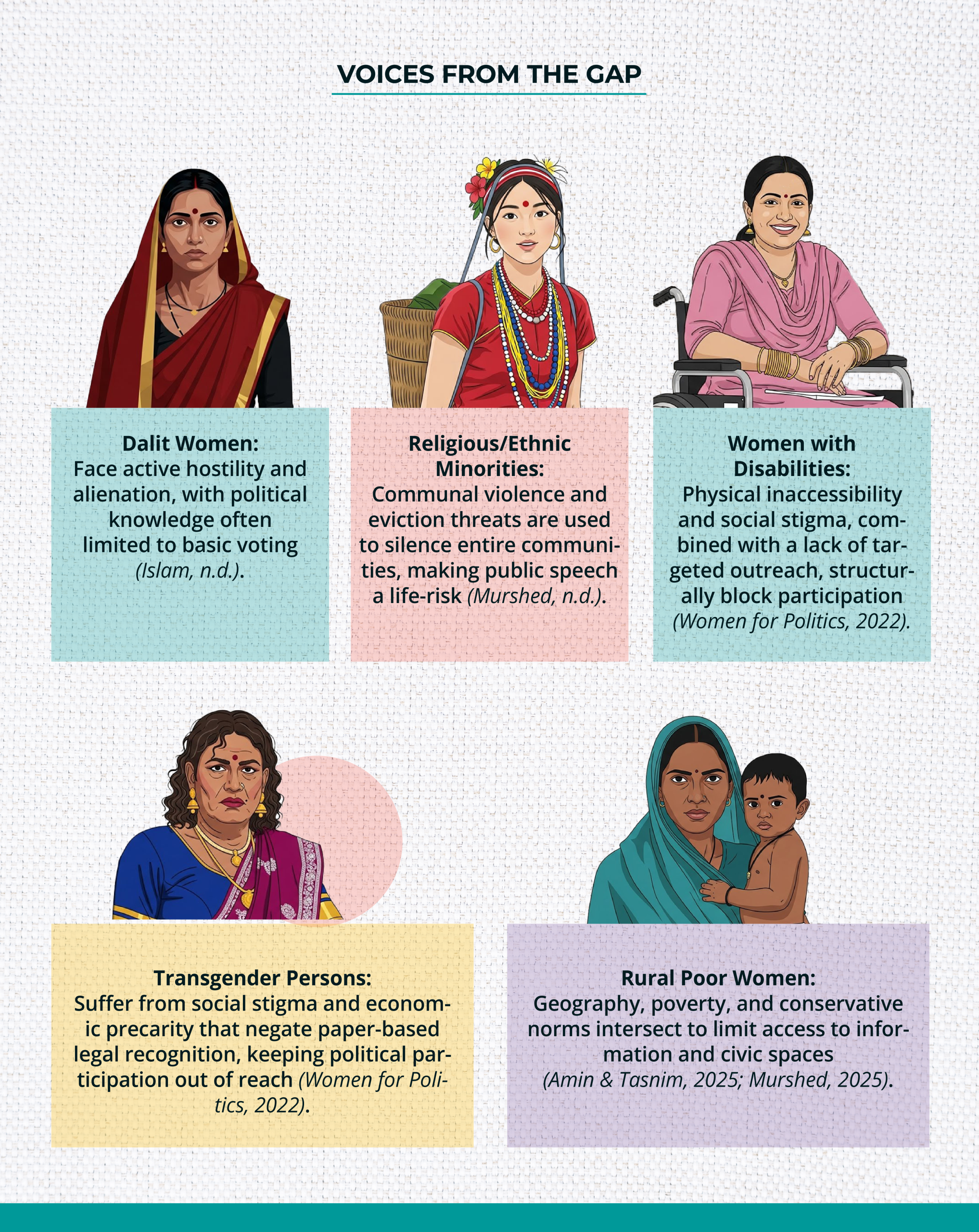
The awareness gap is not uniform. Multiple identities intersect to create deeper exclusions.
- 𝐃𝐚𝐥𝐢𝐭 𝐰𝐨𝐦𝐞𝐧: caste and class combine to produce severe deprivation. Many Dalit women have only the most basic civic knowledge (voting), while literacy and economic precarity block deeper engagement (Islam, n.d.). They report alienation and direct hostility; in extreme cases, officials and neighbours treat them as outsiders (Islam, n.d.). For Dalit women, political knowledge rarely extends beyond the ballot.
- 𝐓𝐫𝐚𝐧𝐬 𝐚𝐧𝐝 𝐠𝐞𝐧𝐝𝐞𝐫-𝐝𝐢𝐯𝐞𝐫𝐬𝐞 𝐩𝐞𝐨𝐩𝐥𝐞: legal recognition (for example, “third gender” registration) exists on paper, but social stigma, economic precarity, and exclusion from employment and services mean political participation remains largely out of reach (Wallen, 2019; Women for Politics, 2022).
- 𝐖𝐨𝐦𝐞𝐧 𝐰𝐢𝐭𝐡 𝐝𝐢𝐬𝐚𝐛𝐢𝐥𝐢𝐭𝐢𝐞𝐬 (𝐏𝐖𝐃): physical access barriers to polling stations, meetings, and public forums, combined with social stigma and a lack of targeted outreach, prevent meaningful inclusion (Women for Politics, 2022). Accessibility shouldn’t be an add-on; it’s central to political agency.
- 𝐑𝐞𝐥𝐢𝐠𝐢𝐨𝐮𝐬 𝐚𝐧𝐝 𝐞𝐭𝐡𝐧𝐢𝐜 𝐦𝐢𝐧𝐨𝐫𝐢𝐭𝐢𝐞𝐬: communalized violence, eviction threats, and property grabs can be used strategically to silence entire communities (Murshed, n.d.). When collective security is threatened, public speech becomes a life-risk.
- 𝐑𝐮𝐫𝐚𝐥 𝐩𝐨𝐨𝐫 𝐰𝐨𝐦𝐞𝐧: geography and poverty interact. Limited access to media, slower penetration of digital skills, and conservative social norms all reduce opportunities for civic growth . (Amin & Tasnim, 2025; Murshed, 2025)
- 𝐘𝐨𝐮𝐧𝐠𝐞𝐫 𝐰𝐨𝐦𝐞𝐧 𝐯𝐬 𝐨𝐥𝐝𝐞𝐫 𝐠𝐞𝐧𝐞𝐫𝐚𝐭𝐢𝐨𝐧𝐬: there is an intergenerational split. Younger feminists and digitally-native activists use different tactics; flash mobs, online campaigns, visible protest, and show high civic energy (Amin & Tasnim, 2025; Sabur, 2022). Older systems and organizations may provide mass membership but less digital agility. Bridging these generational modes is crucial.

𝗗𝗶𝗮𝗴𝗻𝗼𝘀𝗶𝘀, 𝗗𝗲𝗰𝗶𝘀𝗶𝗼𝗻, 𝗮𝗻𝗱 𝗗𝗲𝗺𝗼𝗰𝗿𝗮𝗰𝘆
The awareness gap in Bangladesh reveals that democracy requires more than women’s voter turnout; it demands their genuine political power. This gap is sustained by systemic patriarchy, violence, and exclusion. Closing it is a political choice.
Will the nation transform women’s participation into real agency, or accept it as rhetoric? The future of democracy depends on this decision.
𝗥𝗲𝗳𝗲𝗿𝗲𝗻𝗰𝗲𝘀:
- Amin, M. R., & Tasnim, M. (2025). Digital divide and participatory outcome in politics among youth: A comparative analysis between Generation Z and millennial youth in Bangladesh. International Journal of Research and Innovation in Social Science, 9(2), 972–987. https://doi.org/10.47772/IJRISS.2025.9020078
- Anam, S. (2025, March 8). International Women’s Day: Fight to increase women’s political participation. The Daily Star. https://www.thedailystar.net/news/bangladesh/news/international-womens-day-fight-increase-womens-political-participation-3841991
- BRAC Institute of Governance and Development. (2025, March 17). টং আলাপ Episode 003 – Gender gaps in optimism: Are women in Bangladesh losing hope? BRAC Institute of Governance and Development. https://bigd.bracu.ac.bd/%E0%A6%9F%E0%A6%82-%E0%A6%86%E0%A6%B2%E0%A6%BE%E0%A6%AA-tong-conversations-episode-003-gender-gaps-in-optimism-are-women-in-bangladesh-losing-hope/
- Ferdous, J. (2019). Representation of women in parliament of Bangladesh: Is it hopeful? Journal of Government and Public Policy, 6(2). https://doi.org/10.18196/jgpp.v6i2.6099
- Haque, R. (2023, March 17). Political violence deters women from politics in Bangladesh. Prothom Alo. https://en.prothomalo.com/opinion/cwkymm2eqv
- Hasan, M. (n.d.). Women in political power structures and decision making: Bangladesh context.
- Hassan, M. M., Aziz, S. S., Mozumder, T. A., Hoque, R., Tasnim, S., & Chowdhury, S. (2024). The state of Bangladesh’s political governance, development, and society: According to its citizens — A survey of the Bangladeshi people. The Asia Foundation.
- Islam, F. (n.d.). Political participation of Dalit women in Dhaka city, Bangladesh.
- Luthfa, S. (2025, November 5). Women in politics, politics of women in Bangladesh. Prothom Alo. https://en.prothomalo.com/opinion/op-ed/5a609weyfk
- Murshed, R. (2025). Are women more or less likely to vote than men? Evidence from rural Bangladesh. World Development Perspectives, 38, 100683. https://doi.org/10.1016/j.wdp.2025.100683
- Murshed, S. M. (n.d.). Democracy and minority rights in Bangladesh.
- Quasem, M. A. (2009). Political awareness of women at the grass root level in Bangladesh: A study of Sailkupa Upazilla in Jhenidah District. http://rulrepository.ru.ac.bd/handle/123456789/413
- Rahman, F. (2014). Patriarchy and women’s parliamentary representation in Bangladesh (Master’s thesis). Lund University, Department of Political Science. https://lup.lub.lu.se/student-papers/record/4229029/file/4229044.pdf
- Sabur, A. P. S. (2022). Radical within limits: Women’s movements, civil society, and the political field in Bangladesh. Melbourne Asia Review. https://melbourneasiareview.edu.au/radical-within-limits-womens-movements-civil-society-and-the-political-field-in-bangladesh/
- Schuler, S. R., Islam, F., & Rottach, E. (2010). Women’s empowerment revisited: A case study from Bangladesh. Development in Practice, 20(7), 840–854. https://doi.org/10.1080/09614524.2010.508108
- Shahria, S. (2025). Women’s rights, the Constitution of Bangladesh and reality: A review. Advances in Applied Sociology, 15(2), 75–84. https://doi.org/10.4236/aasoci.2025.152005
- The Business Standard. (2025, October 13). 68% of female and 46% of male voters unaware of PR system: Survey. The Business Standard. https://www.tbsnews.net/bangladesh/68-female-and-46-male-voters-unaware-pr-system-survey-1259506
- UNB. (2025, November 18). Bangladesh’s voters climb to 12.77cr: EC. The Daily Ittefaq. https://en.ittefaq.com.bd/14281/bangladesh%E2%80%99s-voters-climb-to-12.77cr-ec
- Wallen, J. (2019, June 8). Transgender community in Bangladesh finally granted full voting rights. The Telegraph. https://www.telegraph.co.uk/global-health/climate-and-people/transgender-community-bangladesh-finally-granted-full-voting/
- Women for Politics. (2022, July 21). Women’s political leadership in Bangladesh: Intersectionality, accessibility and way forward. Women for Politics. https://www.womenforpolitics.com/post/women-s-political-leadership-in-bangladesh-intersectionality-accessibility-and-way-forward
- প্রতিবেদকঅ. (n.d.). নারীর রাজনৈতিক সচেতনতা [Women’s political awareness]. Dainik Janakantha.